
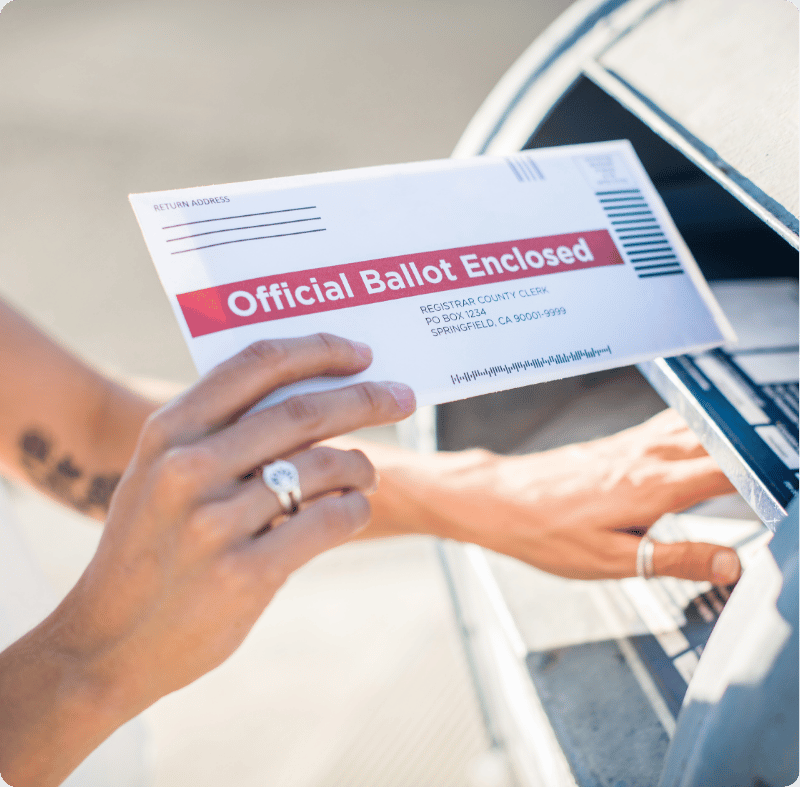
The United States Postal Service (USPS) published a new rule that took effect on December 24, 2025, stating that mail might not receive a postmark on the same day the Postal Service takes possession of it, i.e., the day you mail it.
Because election officials in many states qualify mail-in ballots based on the postmark date, this new rule causes problems for thousands of eligible voters who rely on mail-in ballots, putting them at risk for having their votes disqualified should their ballots be postmarked past the deadline—despite having mailed them prior to Election Day.
Additionally, delayed postmarking could affect voter registration forms and absentee ballot applications, which also rely on postmark dates to determine whether deadlines are met.
In all 44 states covered by the National Voter Registration Act , election officials have to accept voter registration applications postmarked by the deadline, meaning the new rule will affect who gets access to a ballot in the first place.
The USPS claims it isn’t changing its postmark policy, but is instead merely codifying existing practices.

This rule change goes into effect at a time when mail voting has been under increasing attack. The current administration has called for a complete ban on mail-in ballots and the Supreme Court is preparing to rule on the constitutionality of “grace period” laws that allow states to count ballots that arrive after Election Day. In 2025, four states — Kansas, North Dakota, Utah, and Ohio — eliminated their grace periods.
Mail-in voting has never been more widely used—31% of Americans voted by mail in 2024, and a Pew Research poll found that a 58% majority of Americans favors expanded early voting. During the 2020 general election, at the height of the COVID pandemic, mail-in voting surged in popularity, with 43% of all votes cast by mail. That percentage has fallen, but in 2024 still amounted to a third of all ballots cast.
The stakes are particularly high for elderly voters, voters who do not drive, voters with disabilities, and rural voters because voters in these groups lack easy access to alternatives, such as in‑person voting or ballot drop boxes for mail voting, and to other methods like motor voter and online voter registration to register to vote. If their postmarks are delayed, they likely have no backup options to vote—despite mailing in the same way they used to.

Even though dropboxes may be permitted in certain states, they are not always required. Always check with your local election authority for details.
Fourteen states and Washington, D.C. have grace periods for ballots that voters fill out by Election Day but arrive after, meaning that they count ballots that arrive after Election Day if they are postmarked before or on Election Day. Additional states have specific grace periods just for overseas and military ballots. In these grace period states, even small delays in processing can result in voter disenfranchisement, because ballots that were mailed by Election Day are at risk for disqualification if the application of the postmark is delayed.
One way of avoiding postal service delays is to utilize ballot collection boxes; however, several of the states with grace periods, such as Texas, Mississippi, and West Virginia, do not provide boxes where voters can simply drop off their ballot. Therefore, absentee voters in these states are completely reliant on the Postal Service, especially those in remote or rural areas.
One USPS practice driving the new rule is that postmarks are now often applied at central processing centers rather than at the local post office when the USPS first takes possession of a piece of mail. The majority of processing centers are located near big cities and urban areas, further impacting voters in rural and remote areas.
The upshot is that even if voters mail their ballots a day or two before Election Day, it could mean that they will not be counted. During the 2024 election, 584,463 mail ballots were rejected by election officials, roughly 1.2% of all completed mail ballots. 18% of those ballots were rejected because they didn’t arrive at election offices on time.
Even though dropboxes may be permitted in certain states, they are not always required. Always check with your local election authority for details.
1
The easiest thing you can do is to complete and mail your ballot as early as possible, preferably at least two weeks prior to Election Day.
2
You can mail your ballot in person at your local post office and request a manual postmark free of charge by asking the postal clerk to hand-stamp a postmark (sometimes called “hand-cancellation”) on your mail-in ballot .
3
In states that provide them, use ballot collection drop-boxes instead of relying on the Postal Service.
4
If you are able, you have the option to drop off your ballot at your local election office.
5
If you are unable to take any of the above steps, and it is less than one week before Election Day, call your local election official for advice on how to make sure your vote counts.
6
If you have any questions about making sure your mail-in ballot is counted, you can call the Election Protection hotline at 866-OUR-VOTE
Fair Elections Center and Campus Vote Project intend the information contained herein to be used only as a general guide. These guides should not be used as a substitute for consultation with a licensed legal professional from the state in which you reside.
Last Updated: January 30, 2026